
Pixie Haircuts for Women Over 60: The Complete Guide to Cuts, Care, and Confidence

Pixie haircuts for women over 60 offer something genuinely valuable at this stage of life: a bold, confident change that also happens to work considerably better with hair that’s naturally becoming finer, coarser, or more heavily gray. Rather than fighting these genuine texture changes, a well-executed pixie concentrates existing volume into a shorter, more manageable length, often producing results that look fuller and more polished than the same hair worn long ever could.
This guide goes beyond a basic photo gallery. It explains how pixie cuts should be specifically adjusted for hair that’s changed texture and density with age, the cutting techniques that make the biggest visible difference at this stage, and details most articles skip entirely like why the same pixie length can behave completely differently depending on how the crown is shaped for genuinely thinning versus genuinely coarsening hair. Whether you’re considering this cut for the first time or want more from the pixie you already have, this is the deeper, more practical resource.
Why Pixie Haircuts Work So Well for Women Over 60
Hair undergoes genuine, measurable changes by this decade, and understanding them explains why pixie haircuts for women over 60 are so consistently recommended by experienced stylists. Strand diameter often continues decreasing, overall scalp density can shift further, and hair growth cycles slow considerably, meaning longer hair frequently looks noticeably thinner and less full than it did in previous decades.
Shorter cuts redistribute whatever volume remains into a considerably smaller space, creating a genuinely fuller, healthier appearance without adding any actual density. This concentration effect matters more at this particular stage than it might have decades earlier, since the gap between how hair looks long versus how it looks properly cut short tends to become more pronounced as natural density continues evolving.
A helpful example: a woman who has worn her hair at a medium or long length for most of her adult life might find that transitioning to a pixie haircut at this stage produces a considerably more dramatic, flattering volume improvement than the same length change would have offered her decades earlier, simply because the contrast between long and properly cut short hair becomes more pronounced as texture naturally changes.
Beyond volume benefits, pixie haircuts for women over 60 also tend to save meaningful daily time, a genuinely practical benefit for anyone wanting a polished, put-together look without an extended morning styling routine.
Related Content: https://magzyhair.com/straight-hairstyles-ideas/
The Cutting Technique That Matters Most at This Stage
Achieving genuinely flattering pixie haircuts for women over 60 depends considerably more on precise, texture-specific cutting technique than it might have at younger ages, since hair density and texture changes at this stage require particular attention to avoid a result that looks sparse or, alternatively, unexpectedly bulky depending on individual hair characteristics.
For those experiencing genuine thinning, point-cutting rather than heavy thinning shears tends to work considerably better, removing weight gradually from the very ends rather than throughout the entire strand, preserving more overall density while still creating movement. For those with coarser, thicker gray hair, more substantial thinning throughout the cut’s full depth may genuinely be necessary to prevent bulk.
A helpful example: a woman with genuinely thinning hair who receives a pixie using techniques better suited to thick hair, including aggressive thinning throughout, might find her cut looks considerably sparser than intended, while a woman with coarse, thick gray hair receiving only minimal, surface-level thinning might find her pixie looks bulkier and harder to manage than she’d hoped.
Communicating your specific hair changes explicitly during a consultation, rather than assuming a stylist will automatically know which approach your particular hair now needs, helps ensure pixie haircuts for women over 60 are genuinely tailored to current texture rather than an outdated assumption about what your hair used to be like.
Longer Pixie for a Gentler, More Gradual Transition
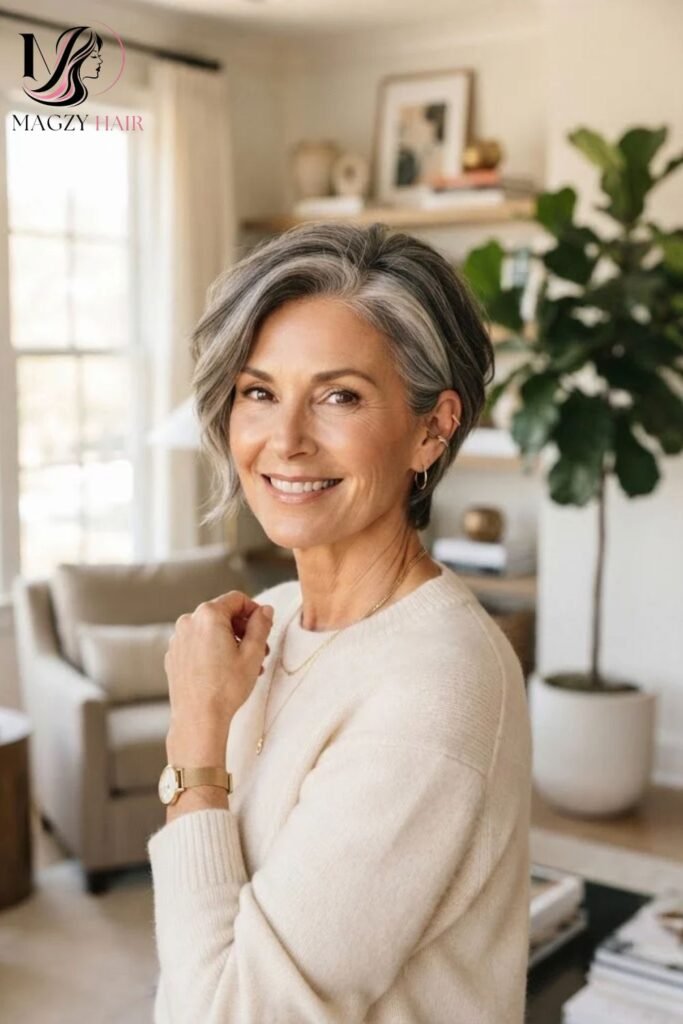
A longer pixie, retaining more length through the crown and front while keeping the sides shorter, offers a genuinely comfortable entry point among pixie haircuts for women over 60, particularly for those transitioning from significantly longer hair for the first time at this stage of life.
This version allows for meaningful styling flexibility, since there’s enough length at the top to create a small amount of directional movement or a subtle side-swept effect, options that can feel considerably less severe and more familiar than the most closely cropped pixie variations for someone accustomed to more length.
A helpful example: a woman nervous about committing to a very short, closely cropped pixie might find a longer variation offers a considerably more comfortable transition, since the additional length at the crown provides a softer, more gradual change that still delivers meaningful styling time savings and the volume-concentrating benefit discussed earlier.
Maintenance for a longer pixie tends to be slightly more forgiving than the most closely cropped versions, generally requiring trims every 5–6 weeks, since the additional length provides more room for growth before the cut’s shape becomes noticeably compromised.
Classic Cropped Pixie for Bold Confidence
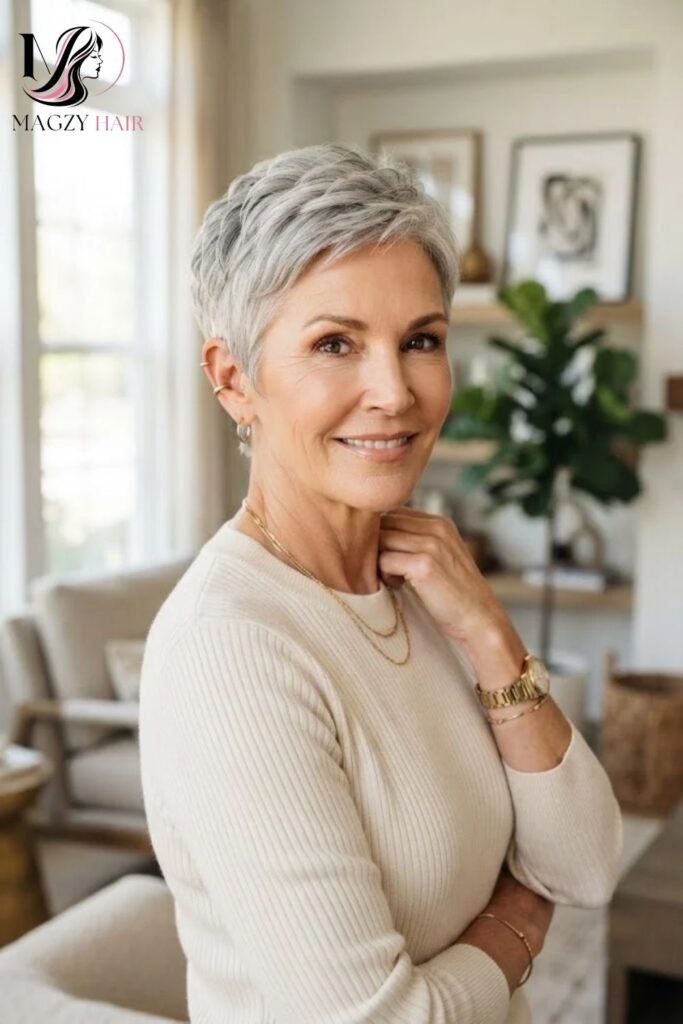
A classic, more closely cropped pixie represents one of the boldest options among pixie haircuts for women over 60, offering a striking, confident look that many women find genuinely liberating at this stage, particularly those ready to embrace a dramatic, low-maintenance change after decades of longer hairstyles.
This style requires skilled, precise execution specifically suited to current hair density, since there’s minimal length available to disguise any unevenness in the underlying cutting technique. Strategic texturizing around the crown helps create movement and volume regardless of whether hair has become finer or coarser during this particular decade.
A helpful example: a woman with predominantly gray or white hair who has always assumed a closely cropped pixie would look severe might find the opposite genuinely true once properly executed, since this length showcases gray hair’s distinctive shine and texture particularly well, often reading as strikingly modern and confident rather than aging.
Maintenance for a classic cropped pixie among pixie haircuts for women over 60 requires trims every 3–4 weeks, a schedule worth weighing against the style’s undeniable visual impact and the genuine daily styling time this length ultimately saves.
Pixie Haircuts for Women Over 60 With Fine, Thinning Hair
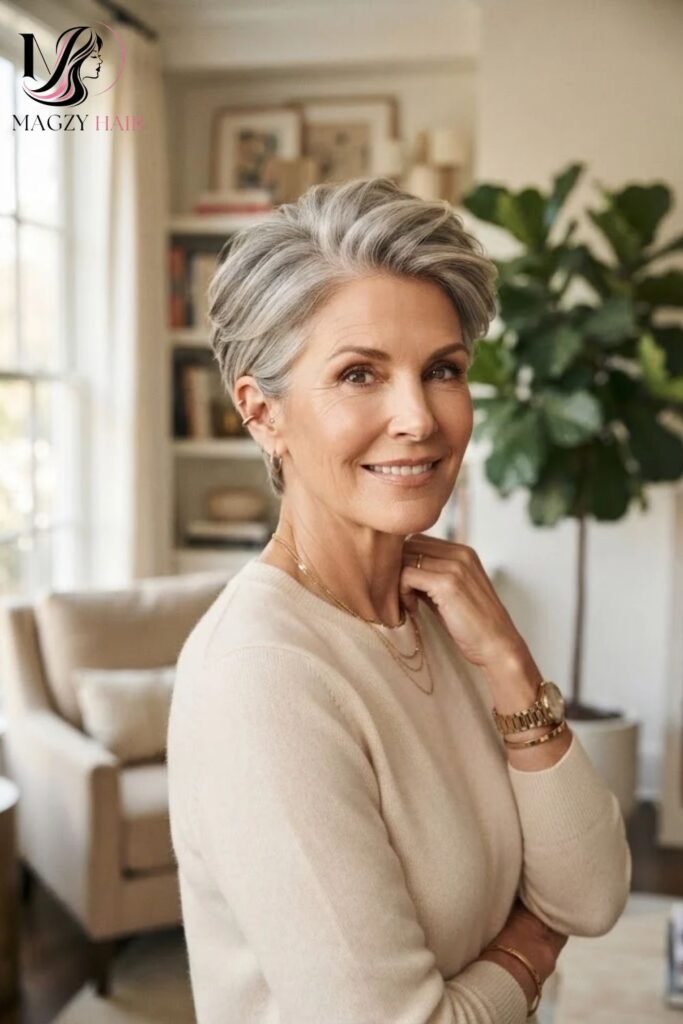
Fine or genuinely thinning hair, a common experience for many women during this decade, requires particularly thoughtful cutting to avoid making pixie haircuts for women over 60 look even sparser than intended. Contrary to a common assumption, heavy layering isn’t always the right solution, since excessive thinning can create wispy, insubstantial results that emphasize rather than disguise thinning areas.
A more conservative approach, using point-cutting rather than heavy thinning shears throughout, tends to work considerably better for this specific hair type at this particular stage. This technique removes weight gradually from the very ends rather than throughout the entire strand, preserving more overall density while still creating meaningful textured movement.
A helpful real-world example: a woman with visibly thinning hair who requests heavy, choppy texturizing throughout her pixie might be disappointed with a sparse, uneven-looking result, while a stylist experienced specifically with thinning hair typically recommends keeping more weight through the crown, since this area often shows thinning most noticeably, while using lighter texturizing elsewhere throughout the cut.
Volumizing cutting techniques, combined with strategic root-lifting products during daily styling, make a meaningful difference for fine, thinning hair specifically, since a cut designed with volume-building in mind from the first snip tends to look considerably fuller day-to-day than one relying entirely on styling to compensate afterward.
Pixie Haircuts for Women Over 60 With Coarse, Gray Hair
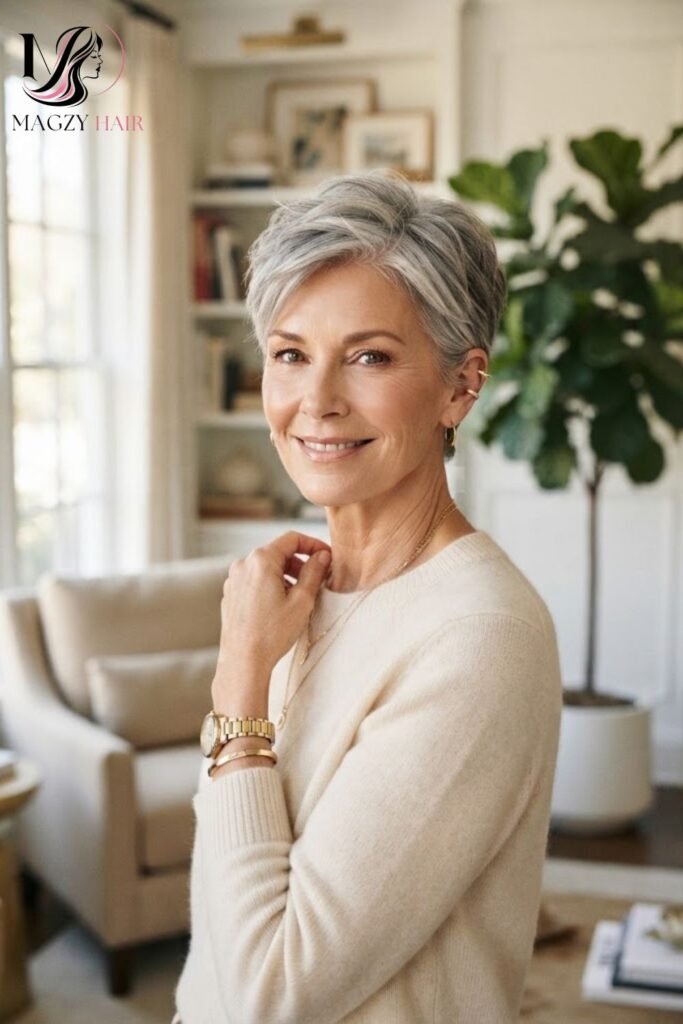
Coarse or thick gray and white hair, common for many women by this stage, requires a genuinely different cutting strategy than fine hair within pixie haircuts for women over 60. Here, the priority typically shifts from creating volume to managing and controlling existing fullness, using thorough thinning to remove bulk without leaving the cut looking heavy or difficult to style.
Gray and white hair specifically often becomes somewhat more resistant to lying flat than previously pigmented hair, meaning cuts need genuinely appropriate thinning and precision to control shape effectively. Slide-cutting techniques, which remove weight gradually along the length, work particularly well for managing this particular texture within a pixie specifically.
A practical example: a woman with thick, coarse, fully gray hair who receives minimal thinning during her pixie cut may find the style looks bulky or difficult to control, even at this considerably shorter length. Increasing internal thinning, particularly around the crown and sides, typically resolves this by removing enough weight to let the cut fall into a considerably more polished, intentional shape.
Gray hair also reflects light distinctively compared to pigmented hair, meaning well-executed pixie haircuts for women over 60 on this hair color often showcase texture and dimension in a particularly striking way, making thoughtful, texture-specific cutting a genuinely worthwhile investment.
Pixie Haircuts for Women Over 60 by Face Shape
Face shape continues mattering significantly when choosing among pixie haircuts for women over 60, since this shorter length draws considerably more direct attention to facial features than longer styles typically do. For round faces, added height at the crown paired with longer, side-swept front pieces tends to elongate the face, while very short, uniformly rounded styles can sometimes emphasize width instead.
Square faces generally benefit from softer, more textured layering rather than sharp, geometric edges, since gentle movement helps soften a strong jaw without requiring any change to the underlying bone structure itself, a consideration that remains relevant regardless of hair density or texture changes.
A helpful example: a woman with a round face who requests a very short, evenly rounded pixie without additional crown height might find the combination of her face shape and this particular cut’s shorter length creates more width than intended. Adjusting to include crown height and longer front pieces typically achieves a considerably more balanced, flattering result while still working effectively with current hair density.
Consulting with a stylist about specific face-shape priorities, alongside the age-related texture considerations discussed throughout this guide, leads to considerably more personalized, flattering recommendations than addressing either factor alone.
Styling Tips to Keep Pixie Haircuts Looking Full
Even a genuinely well-cut pixie benefits significantly from the right daily styling approach, particularly when combating natural volume changes common at this stage of life. Applying a lightweight volumizing mousse to damp roots before drying, then blow-drying with a small round brush focused specifically at the crown, creates lift precisely where most needed, rather than relying on the cut alone to generate fullness.
Root-lifting sprays, applied directly at the scalp before any other styling product, offer another effective volume-building technique particularly useful for pixie haircuts for women over 60 on finer, thinning hair. Unlike heavier styling creams, these lightweight formulas add genuine lift without weighing hair down, which matters considerably at this shorter length where any extra product weight becomes immediately noticeable.
A helpful example: blow-drying by simply pointing the dryer downward from above, a common but often counterproductive habit, frequently flattens volume rather than building it, while directing airflow briefly against the direction of hair growth at the roots, before smoothing hair into its final shape, creates noticeably more lasting lift throughout the day.
For those wanting minimal daily styling effort, a texturizing spray applied to dry hair, followed by lightly scrunching with fingers, can refresh volume and definition on day two without requiring a full restyling session.
Color Techniques That Enhance Pixie Haircuts for Women Over 60
Color placement plays a particularly meaningful role in how pixie haircuts for women over 60 read visually, since this short length draws considerable direct attention to the face and displays color on immediate, concentrated view. Soft, dimensional highlights placed strategically throughout can enhance a pixie’s texture and movement considerably more effectively than flat, single-process color.
For those specifically embracing fully gray or white hair, purple or silver-toning treatments help maintain bright, clear tones rather than allowing yellow or dull cast to develop over time, a particularly valuable maintenance consideration for this specific color and length combination.
A helpful example: a pixie styled with flat, single-process color often looks noticeably less dimensional than the identical cut finished with strategic highlighting, since the color simply reveals and enhances the texturizing already built into the cut itself, a distinction that becomes considerably more visible given this length’s concentrated color display.
For those still transitioning to fully gray hair, subtle lowlights blended throughout pixie haircuts for women over 60 can help ease this color journey while still adding genuine dimension and texture, working particularly well given how directly this short length showcases color placement throughout.
Common Mistakes to Avoid With Pixie Haircuts for Women Over 60
One frequent mistake is choosing a specific pixie style based purely on a trend photo without considering current hair texture, density, and gray coverage, all factors that genuinely continue evolving throughout this decade in ways that can make a cut chosen for someone else’s hair considerably less flattering on your own current texture.
Over-thinning genuinely thinning hair remains a commonly repeated error, since excessive texturizing can create sparse, patchy-looking sections that undermine the fuller appearance pixie haircuts for women over 60 are generally meant to achieve. Clearly communicating hair density changes to your stylist, rather than simply requesting texture without further context, helps avoid this frequently made mistake.
Skipping regular trims is a mistake with particularly visible consequences for this length specifically, since pixie haircuts rely on precise, well-maintained shaping to look intentional rather than simply grown-out. Waiting too long between trims often results in a style that loses its defining shape well before it appears obviously overdue.
Finally, using heavy, matte styling products can work directly against the natural shine and dimension a well-cut pixie is meant to showcase, particularly since hair can develop a duller texture with age. Choosing lightweight, shine-enhancing formulas ensures daily styling supports rather than diminishes the cut’s overall polished appearance.
Transitioning to a Pixie for the First Time at This Stage
For women transitioning to pixie haircuts for women over 60 for the first time, understanding what to expect eases any hesitation about making such a significant change. The first few weeks often involve a genuine adjustment period, both in terms of how the new length feels and in learning updated styling techniques suited to this shorter length rather than long-hair habits developed over many previous decades.
A gradual transition approach works particularly well for those hesitant about an immediate, dramatic change, starting with a longer, lightly layered bob and progressively going shorter with subsequent trims, allowing for a considerably more comfortable adjustment period than cutting directly to a significantly shorter pixie length in a single appointment.
A helpful real-world example: a woman transitioning from shoulder-length hair directly to a very short, closely cropped pixie in one appointment often experiences more adjustment difficulty than someone who first moves to a longer bob, then progressively shortens over several appointments across a few months, a staged approach that typically produces considerably more confidence with the eventual result.
Bringing multiple reference photos showing different texturizing intensities and crown heights, rather than just one specific style, helps communicate preferences more effectively during this particular transition, giving your stylist a clearer sense of your comfort level.
The Future of Pixie Haircuts for Women Over 60
Pixie haircuts for women over 60 continue to evolve alongside a broader industry shift toward more personalized, texture-specific cutting rather than generic, one-size-fits-all approaches applied uniformly across this entire age bracket. As more stylists receive specialized training in cutting for changing, mature hair textures, short cuts are becoming increasingly tailored to individual density and texture changes.
There’s also growing recognition within the hairstyling industry that women over 60 deserve dedicated styling attention genuinely reflecting age-related hair changes, rather than being offered a narrow, outdated set of style options that don’t account for the genuine texture and density variations common at this particular stage.
Low-maintenance, air-dry-friendly cutting techniques are also likely to continue growing in popularity within this category, as more women prioritize haircuts that look genuinely polished with minimal daily styling effort, aligning with broader lifestyle trends favoring efficiency without sacrificing a put-together appearance.
Looking further ahead, increased representation of women over 60 confidently wearing pixie haircuts in mainstream hairstyling content is likely to continue expanding the range of styles specifically showcased and recommended for this age group, helping ensure future guides reflect a genuinely inspiring, accurate range of options.
Conclusion
Pixie haircuts for women over 60 offer a practical, genuinely flattering solution for hair that’s changing with age, combining reduced styling time with a fuller, more polished appearance. From longer, gentler variations to bold cropped versions, there’s a style suited to nearly every face shape and hair texture at this stage of life. If you’ve been considering a change, use these ideas as a starting point for your next conversation with a trusted stylist.
Ayesha Noor is the founder and lead writer behind Magzy Hair. With 4 years of experience researching hairstyles, hair care, and beauty trends, she enjoys helping readers discover styles that suit their unique personality and lifestyle.


